Solid Geometry ;
Solid geometry is the geometry of 3 - dimensional spaces. It is called three dimensional , or 3D because there are three dimensions width , length and height.
Solids have properties that are special :
- Surface Area ( think of the area of the faces and curved surface of a solid figure)
- Surface Area ( think of the area of the faces and curved surface of a solid figure)
- Volume ( Think about how much water the figure can hold )
There are two types of solids :
- Polyhedra
- Non- Polyhedra
Polyhedra includes Prisms, Pyramids and Platoric Solids

 |
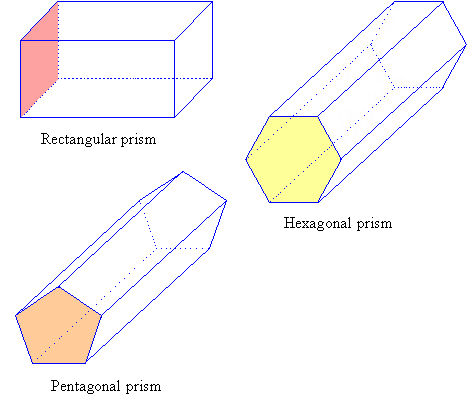
| There are many different types of Prisms |
Non- Polyhedra includes Spheres, Cylinder, Cones and Torus
 |
| Torus |
 |
| Sphere |
 |
| Cylinder |
.png) |
| Cone |
Lateral Area & Surface Area
Lateral Area is the sum of the areas of the lateral (vertical) faces of a cylinder, cone and more
Surface
A Prism has the same cross section all along it`s length!
Surface Area = area of the bases + Lateral Area ( area of the sides )
A cross section is the shape you get when cutting straight across an object

A Pyramid is a solid that contains a polygon base to point
the slant height of a pyramid is the height of one of the lateral faces
L.A = 1/2pt * 4
Surface Area = L.A + B( area of the bottom)
Cones : the base of a cone is a circle and the other end (vertex) is the "pointed" similar to a pyramid
The slant height of a cone is the distance from the vertex to a point on the edge of a base
L.A = πrl ( r means radius, and l means Slant height)
B = πr^2
Surface Area = L.A + B
A Cylinder is a geometric figure with straight parallel sides and a circular or oval base
L.A = 2πh or πdh
Surface Area = Lateral Area + Area of a Circle
Surface Area = 2πh + 2πr^2

No comments:
Post a Comment