In Figure 1 , right triangle ABC has altitude BD drawn to the hypotenuse AC.
Figure 1
An altitude drawn to the hypotenuse of a right triangle.
The altitude drawn to the hypotenuse of a right triangle creates two similar right triangles, each similar to the original right triangle and similar to each other.
Figure 2 shows the three right triangles created in Figure 1 . They have been drawn in such a way that corresponding parts are easily recognized.
Figure 2
Three similar right triangles from Figure 1 (not drawn to scale).
AB and BC are legs of the original right triangle; AC is the hypotenuse in the original right triangle; BD is the altitude drawn to the hypotenuse; AD is the segment on the hypotenuse touching leg AB and DC is the segment on the hypotenuse touching leg BC. Because the triangles are similar to one another, ratios of all pairs of corresponding sides are equal. This produces three proportions which are
Here is a video to help you understand better how to solve these problems
Solid Geometry, Lateral Area & Surface Area Solid Geometry ;
Solid geometry is the geometry of 3 - dimensional spaces. It is called three dimensional , or 3D because there are three dimensions width , length and height.
Solids have properties that are special : - Surface Area ( think of the area of the faces and curved surface of a solid figure)
- Volume ( Think about how much water the figure can hold )
There are two types of solids :
- Polyhedra
- Non- Polyhedra
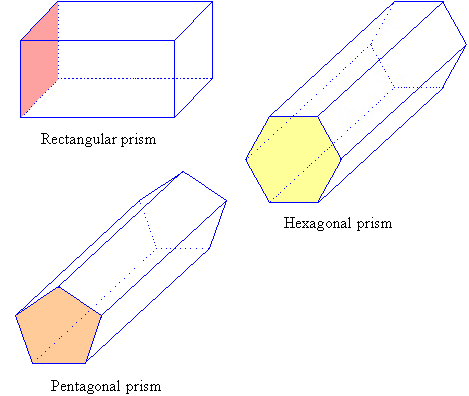
Polyhedra includes Prisms, Pyramids and Platoric Solids
There are many different types of Prisms
Non- Polyhedra includes Spheres, Cylinder, Cones and Torus
Torus
Sphere
Cylinder
Cone
Lateral Area & Surface Area
Lateral Areaisthe sum of the areas of the lateral (vertical) faces of a cylinder, cone and more
Surface
A Prism has the same cross section all along it`s length!
Surface Area = area of the bases + Lateral Area ( area of the sides )
A cross section is the shape you get when cutting straight across an object
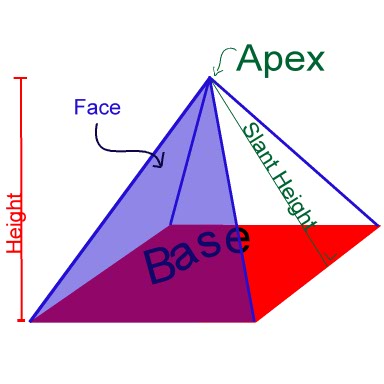
A Pyramid is a solid that contains a polygon base to point
the slant height of a pyramid is the height of one of the lateral faces
L.A = 1/2pt * 4
Surface Area = L.A + B( area of the bottom)
Cones : the base of a cone is a circle and the other end (vertex) is the "pointed" similar to a pyramid
The slant height of a cone is the distance from the vertex to a point on the edge of a base
L.A = πrl ( r means radius, and l means Slant height)
B = πr^2
Surface Area = L.A + B
A Cylinder is a geometric figure with straight parallel sides and a circular or oval base
Dilation:An enlargement or shrinking of a figure by a given scale factor produces similar figures What does the symbol of dilation look like? Notation: Dn where n represents the scale factor rule for a dilation with a scale factor of n
For Example: (X,Y) -> ( nX, nY) A`( 2, 4)->(4,8) when the scale factor is 2 First Step is to multiple the X value by the scale factor Second Step is t multiple the Y value by the scale factor Then you get the "copy" of the original figure Watch this video below for more help on this topic
If the scale factor, N, is greater than 1, the image is an enlargement (a stretch). If the scale factor is between 0 and 1, the image is a reduction (a shrink). Most dilation's in coordinate geometry use the origin, (0,0), as the center of the dilation.
For Example :
PROBLEM: Draw the dilation image of triangle ABC with the center of dilation at the origin and a scale factor of 2.
OBSERVE: Notice how EVERY coordinate of the original triangle has been multiplied by the scale factor (x2).
HINT: Dilation involve multiplication!
Example 2:
PROBLEM: Draw the dilation image of pentagon ABCDE with the center of dilation at the origin and a scale factor of 1/3.
OBSERVE: Notice how EVERY coordinate of the original pentagon has been multiplied by the scale factor (1/3). HINT: Multiplying by 1/3 is the same as dividing by 3!




.png)